Religion in Japan
https://www.humanreligions.info/japan.html
By Vexen Crabtree 2026
#buddhism #china #japan #religion_in_japan #shinto #Soka_Gakkai #zen
Traditional religious practices in Japan are combined under the term Shinto1, but between the 6th and 10th century, it largely transformed into a Buddhist country, often fusing the two traditions. Japan still has a strong Buddhist core and it takes many forms in Japan2, from Zen (originally from China as Ch'an Buddhism)2 to the simplistic Soka Gakkai sect which has 8 million members3. But from 2010 to 2020, overall numbers of Buddhists fell from 42% to 37% of the total population; a corresponding 5.3% fewer Japanese said they belonged to any religion, meaning 57.5% did not affiliate with any religion4.
1. Adherents and Beliefs
#afterlife #belief #buddhism #christianity #god #heaven #hell #hinduism #islam #judaism #religion #religiosity #secularisation #universalism
| Religiosity (2018)5 | ||
|---|---|---|
| Pos. | Lower is better %5 | |
| 1 | China | 3 |
| 2 | Estonia | 6 |
| 3 | Czechia | 7 |
| 4= | Switzerland | 9 |
| 4= | Denmark | 9 |
| 6= | Germany | 10 |
| 6= | UK | 10 |
| 6= | Sweden | 10 |
| 6= | Japan | 10 |
| 6= | Finland | 10 |
| 11= | Latvia | 11 |
| 11= | France | 11 |
| 11= | Belgium | 11 |
| 14 | Austria | 12 |
| 15 | Hungary | 14 |
| 16 | Albania | 15 |
| 17= | Lithuania | 16 |
| 17= | S. Korea | 16 |
| 17= | Russia | 16 |
| 20= | Australia | 18 |
| World Avg | 54.3 | |
| q=106. | ||
| Disbelief In God (2007)6 | ||
|---|---|---|
| Pos. | Higher is better %6 | |
| 1 | Vietnam | 81 |
| 2 | Japan | 65 |
| 3 | Sweden | 64 |
| 4 | Czechia | 61 |
| 5 | Estonia | 49 |
| 6 | Denmark | 48 |
| 7 | France | 44 |
| 8 | Belgium | 43 |
| 9= | Netherlands | 42 |
| 9= | Germany | 42 |
| 9= | UK | 42 |
| 12 | Cuba | 40 |
| 13 | Slovenia | 35 |
| 14 | Bulgaria | 34 |
| 15 | Hungary | 32 |
| 16 | Norway | 31 |
| 17 | S. Korea | 30 |
| 18 | Finland | 28 |
| 19 | Russia | 27 |
| 20 | Australia | 25 |
| World Avg | 9.9 | |
| q=137. | ||
Pew Forum polling over the decades has found the following adherency rates:4:
| 2010 | 2020 | |
|---|---|---|
| Unaffiliated | 52.2% | 57.5% |
| Buddhist | 41.8% | 37.2% |
| Other | 3.63% | 2.89% |
| Christian | 2.21% | 2.25% |
| Muslim | 0.159% | 0.17% |
| Hindu | <0.1% | <0.1% |
| Jewish | <0.1% | <0.1% |
It appears that when asked "What religion are you" many give pollsters the 'correct' answer despite how they actually feel, and despite what they actually believe. Although 42.5% of the populace say they belong to a religion, only 10% say that they are religious when the question is phrased as "Is religion an important part of your daily life?".
For more on this phenomenon, see:
"Institutionalized Religions Have Their Numbers Inflated by National Polls" by Vexen Crabtree (2009)
The CIA World Factbook has slightly different data, and states: Shintoism 83.9%, Buddhism 71.4%, Christianity 2%, other 7.8%. note: total adherents exceeds 100% because many people belong to both Shintoism and Buddhism (2005)7.
The Afterlife: Ipsos-NA in 2011 gathered some statistics on Japan8. Belief in heaven and hell is at just 4%. More people don't know what to believe (37%). Some believe that upon death, you simply cease to exist (37%). Also, 3% specifically believe in heaven but not in hell (which is nice - making them possible "universalists"). 10% believe in reincarnation, which seems very low compared to the numbers of Buddhists.
2. Freedom of Religion and Belief
From the 1950s Japan reformed itself, granting extensive religious freedom to its citizens and attaining one of the lowest rates of violent religious persecution worldwide9. Its Constitution grants "strong protections of freedom of thought, conscience, and religion, as well as a clear separation of religion and state"10.
For more, see:
 3. Shinto
#buddhism #japan #religions #shinto
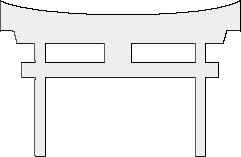
Shinto is the generic native religion of Japan, pre-dating Buddhism to the extent of being prehistorical, and is associated with traditional Japanese culture11. It is animistic - with spirits inhabiting all kinds of objects and places, collectively being called Kami. There are no sacred books nor central authorities12. It's not an exclusivist nor doctrinal religion, although from 1870 a form of state-sponsored nationalist Shinto became forcibly dominant, although this failed and declined after 194513. Shinto then returned to its more relaxed posture. Shinto is an artificial name given to a collection of traditional rituals, practices and beliefs. It accepts a variety of supernatural beings, but none of them amount to being gods and it is therefore listed amongst atheist religions; it is also hailed as being a nature-based religion14 and many of the rituals at shrines are centred on the natural cycle of the seasons12. Shinto is counted as one of the great world religions15,16,17.
For more, see:
- "Shinto" by Vexen Crabtree (2020).
 4. Buddhism
#buddhism #hinduism #india #japan #religion #vedic_faiths
The historical evidence does not make it easy to trace the beginnings of Buddhism except that it sprung out of, and shares many basic beliefs, with Hinduism and other Vedic Faiths. "During the reign of emperor Ashoka (3rd century BCE) Buddhism became a major Indian religion and was subsequently established across the whole subcontinent and beyond"18 and is now counted as one of the great world religions15,19,17,20. It has grown so diverse that it is very hard to define its core nature - in 1913 one scholar pointed out that "in Japan alone it has differentiated itself into thirteen main sects and forty-four sub-sects"21. Buddhism is a well-liked and respected atheist religion22,23,24,25,26,27,28,29,30,31,32,33 and in the West; many attend Buddhist retreats, meditation centres and classes. Western Buddhist communities nearly all run such events for the general public. But in the West many who put "Buddhist" on census forms have merely attended some of these and who have an interest, but are not committed Buddhists, which artificially inflates the numbers.
For more, see:
- "Buddhism" by Vexen Crabtree (2023).
 5. Aum Shinrikyō
#antisemitism #aum_shinrikyo #australia #buddhism #christianity #freemasons #germany #hinduism #japan #mass_murder #religion_in_japan #religious_violence #russia #USA
Aum Shinrikyō was a Japanese apocalyptic religious cult founded in 1987 by Shoko Asahara34, already a convicted fraudster35. It proclaimed armageddon, war and end-times strife using a mix of Buddhism, Hinduism and Christianity36. They embraced a wild array of paranoid conspiracy theories, all with Aum as the sole path to salvation and its cult leader Asahara as the only embodiment of truth. It believed that the USA and Japanese governments were controlled by secretive cabals such as Freemasons and Jews (Asahara admired Hitler). By 1997 they had 10 thousand members in Japan, and 40-50 thousand across Russia, the USA, Germany, Australia and elsewhere37. The group amassed wealth, weapons, chemical laboratories, and sought nuclear weapons. As the Japanese police were investigating the cult after a kidnapping, murders and two previous attempts at mass murder, in 1995 Aum released sarin nerve gas on several Tokyo subway lines, killing 13 people and wounding 3 97638,39, aiming to cause mayhem and trigger the apocalypse.
For more, see: