Religious Clothing and Symbols in Secular Democracies
https://www.humanreligions.info/clothing_and_symbols.html
By Vexen Crabtree 2017
#clothes #democracy #discrimination #politics #religion #religious_clothing #secularism
Legislation on clothing and religious symbols in secular democracies should be based around the principal of maximum freedom, and no compulsion. This means, you can't force people to abide by other people's religious rules, and, people should be as free as possible to wear whatever they want. Therefore, people are free to voluntarily follow whatever religious codes that their religions insist upon. This allows maximum freedom of religion. But there are times when secular law should trump religious rules: (1) Requirements to wear safety equipment, (2) requirements for visual identification, (3) public roles requiring face-to-face communication and (4) to prevent oppression within communities who wish to impose involuntary dress rules. In those cases, secular law can be enacted to limit other's dress in certain situations.
Conversely, laws should not be passed simply because clothing is offensive, unpopular, or disliked. There must be practical reasons behind legal restrictions on dress, not aesthetic ones. Likewise, laws should not be passed to exempt specific religions from requirements that everyone else has to follow (positive discrimination). It is not reasonable to expect rules to be modified to accommodate the strange codes of the world's various religions. The trick is: treat everyone equally and only enforce dress codes where there is good reason. Follow that advice, and there is no need to create religion-specific legislation.
- When Should Practicalities Trump Religious Rules?
- Protecting People's Rights
- Cases
- Legislation on Religious Clothing and Symbols in European Schools
- Blaming Women for Male Lust and Male Lack of Self Control
- Biblical Dress Codes: God's Laws on Clothes
- The Christian Synods of the 12th Century: No Long Hair and No Pointy Shoes
- Religious Clothing Laws As Dangerous Superstitions
- Links
1. When Should Practicalities Trump Religious Rules?
1.1. Safety Equipment (From Helmets to Respirators)
Many dress codes in workplaces are not only sensible, but often increase the safety of the individuals and those they work with. If a person chooses to follow a religion that forbids them from following the dress code required with certain work, then, they should not do that work. There is no requirement for the demands of physical reality to be bent to the idealism of religious dogma.
If you indulged in some type of behaviour that didn't make any sense, had no merit, achieved a mystical goal and was also impractical, then everyone would conclude it was a superstition. The following news report from the UK's National Secular Society brings together these elements in a type of case that has been hitting the press frequently this decade:
“Muslim woman wants religion put before hospital hygiene rules.
A Muslim woman radiographer at a Berkshire hospital is claiming she was discriminated against because she refused to follow the national hospital dress code aimed at combating the spread of superbugs. She has now left her job.The woman refused to follow the ruling that says that arms must be uncovered, either from wearing short-sleeved uniform or by rolling up the sleeves. This policy has been introduced to combat the alarming spread of MRSA and Clostridium difficile.
The woman said Islam teaches that women should dress modestly and cover their bodies while in public, and therefore the rules forced her "to choose between her religious beliefs and her livelihood". She had worked as a therapeutic radiographer for 10 years, and described her situation as a "continuous nightmare". She says she has been "emotionally torn about" over losing her job.
She said that she fears she may not be able to get another job, but has vowed to campaign against the NHS's "bare below the elbows" policy.
The woman, who did not want to be identified, said she wants to "prevent the policy from being universally applied, so other Muslim women do not experience the same trauma."”
National Secular Society (2008)1
Another serious case is military rules on hair length and facial hair. Soldiers must obey such norms for a range of practical reasons. Gas masks cannot form a tight seal with the skin if a beard is present, for example. Some might argue that we should let people adopt decorative facial hair at the expense of having an unusable gas mask, because they alone pay the price for their appearance. But in many industries and trades, this is not the case. Teams survive or fall on their combined strength; if a sentry soldier fails to raise an alarm because he was praying, or succumbed to nerve gas because his beard stopped his respirator from working, he has actually risked the lives of many of his compatriots.
As the Hospital example and military practical necessities show, there are many walks of life where there is a moral responsibility to obey dress codes, and if you cannot abide by them, then you should not be paid to do that job. It is not true that such dress codes are discriminatory or unfair: if anything is unfair, it is the demands of real life. Those who choose to submit themselves to clothing limitations due to their religion should be willing to pay the price for their own voluntary shortcomings.
1.2. Identification and Public Safety
It is an absolute requirement that security, such as at airports, is enforced without exceptions. It is absolutely discriminatory, unfair, unsafe and unreasonable that members of certain religions be exempt from security procedures. If people are exempt, all other passengers should be warned that the plane is compromised. If certain religious adherents wish to avoid security procedures, then they should hire private planes where their dogma does not risk the security of non-adherents.
I am of course mostly talking about certain Islamic prohibitions against women showing their faces to men. It is not a moral requirement that airports attempts to cater for the needs of all religious people who pass through them. People can choose to believe in crazy things, but, it does not then become the responsible of commerce to cater for them.
If someone does not wish to submit to basic security checks - such as looking at an ID card and checking the person is who it depicts - then those people cannot pass those security checks. This is not discrimination - as mentioned above - it is a much greater discrimination to put all passengers at risk.
1.3. Jobs That Require Communications Skills Should Not Allow Face-Coverings
Interpersonal communication relies heavily on body language and much of that is facial. Charles Darwin took photos of facial expressions from around the world, and surveyed people around the world asking them which emotions were being conveyed; the results proved that facial expression are universal in nature2. Not only are facial expressions recognised universally by humans, but we also depend on visual clues for accurate, meaningful conversation. Such behaviours are built into us genetically - blind children exhibit them the same way as sighted children3. Without the visuals of facial expressions, communication is hindered. The lack of visual cues is what makes phone conversations and purely textual expressions to be more prone to incidental misunderstandings and disagreements.
It is certainly not right for officials, teachers or those who work face to face with customers, to be wearing such concealing clothes. In all public-sector jobs where employees relate in person to customers, all face-coverings should be absolutely banned. Likewise, there should be no legal compulsion for any commercial company to allow public-facing roles to be facially covered. Companies may choose to allow face-coverings if they want, but, it is not a matter of discrimination if they do not allow them, as such coverings negatively affect communication.
1.4. Preventing Harassment Within Minority Communities
Some governments have experimented with allowing religious communities to legally impose their own religious laws within certain geographical boundaries. The problem is, many moderate religionists don't want to go along with a stricter enforcement, but go along due to social pressure. National governments must protect individuals within religious communities from the community itself. In practice, it is very difficult to grant a community rights to run itself along religious grounds without indirectly authorising discrimination and prejudice. Minorities within minorities that are especially at risk include non-conformist members of the religion, homosexuals, women and others who are often the victims of traditional religious prohibitions. In Atheneum, the Belgium school, when the school finally changed its dress code and banned headscarves, some of the older girls thanked the head teacher, saying "you've no idea of the pressure we were under".
Wherever a dress code combines religion, culture and sectarianism, the compulsion to conform can transcend healthy limits. But likewise, the reactionary policies of law can go too far when they try to curb this problem, because it is also a matter of civil liberty that people be free to wear what they want as much as possible.
“The issue of the headscarf is complex and multifaceted. Many Muslim women may indeed wear a headscarf involuntarily, because of social pressure by family or even harassment by their peer group, but others choose to wear it either on religious grounds, as an assertion of Muslim identity or as a culturally defined display of modesty.”
"Muslims in the European Union: Discrimination and Islamophobia" by EUMC (2006)4
2. Protecting People's Rights
2.1. Don't Discriminate Against Religions or Cultures
#discrimination #france #islam #judaism
Schools, state employees and officials who are all responsible for contact with the general populace should be given clear, universal guidelines as to what is acceptable with regards to appearance and good communication skills. Either you allow sectarian clothing that divides people strictly into groups, or, you do not allow it. Allowing it might present a more friendly face to clients, but might also limit communication with others. It is prejudicial; and in a democracy, wrong; to pick out certain religions. A policy for security might be that faces must be uncovered; and a policy for schools might be that no religious symbols are to be displayed, or that pupils and teachers must be able to see each other's facial expressions. A discriminatory policy is that Muslims can't cover up but chavs and townies can continue to wear concealing baseball caps and hoods. Rules should be phrased universally and in a religion-neutral way.
If policy is explained carefully and neutrally, many conflicts can be avoided.
“A 12-year-old Muslim girl wearing a traditional Islamic head scarf (hijab) at a state school prompted officials in 2003 to expel her, saying the head covering represented a religious statement in a secular school. This incident, and others like it, precipitated vitriolic public debate about the place of religious symbols [...]. When President Jacques Chirac supported the girl's expulsion - on the principal that religion should not be permitted in public schools - Islamic leaders protested that the ban was prejudicial, singling out Muslims for discriminatory treatment while Catholic students were allowed to wear crosses in school and Jewish boys were allowed to wear skull caps. [...]
The headscarf controversy had stated in 1989 with the first cases of Muslim school girls refusing to uncover their heads. [...] By 2003 there were 1,200 cases of veiled girls attending state schools, but only four were expelled.”
"Religion in schools: controversies around the world" by R. Murray Thomas (2006)5,6
After secularist laws were passed in 2004, the numbers of veiled Muslim girls dropped to 240 in France's state schools6. It was therefore revealed that three-quarters of the Muslim pupils could dispense with their coverings and continue attending school without them, even if they didn't like it. Most pupils are prone to disliking their uniforms; France has shown generally that strictness can overcome sectarianism and rebellion. Some have protested that Jewish skullcaps and Catholic crosses are still visible, and this text would urge that it is made clear exactly what is banned, and why. Ban face-coverings in the name of good communication, or ban all overt signs of religion in the name of public secularism, but do not discriminate and ban certain religious symbols, as that'll just cause continual resentment and is biased.
2.2. Pastafarians, Goths and Weirdos
Some people just like to wear uncommon clothes, in strange ways. If you ban Islamic full-body covering, people would merely call it something else. You can't start banning clothes merely because they are unpopular with the masses; goths are unpopular but that is hardly grounds, in a democracy, for banning their clothes. There is a balance to be sought between avoiding mob rule where the masses punish minorities through direct or indirect discrimination, and progress, where intolerant and harmful practices are curbed.
One fun new religious movement is the Pastafarians, who are partial to wearing colanders on their heads, and have had a series of battles with authorities in order to have the same freedom that other (religious) people have. Their battles highlights the fact that creating exemptions from rules for specific religions is an inherently unfair and unstable practice.
See: "Pastafarianism (Church of the Flying Spaghetti Monster)" by Vexen Crabtree (2017).
Another active group is BOEH (Boss of My Own Head), a Dutch feminist group that campaigns against rules on clothing. Their membership is diverse, including Muslims. Its members protest in a fun manner, wearing all kinds of daft things on their heads, from kitchen appliances to toys.7. Although their message is good-hearted, I do wonder how they would instead endeavour to keep children free of the unhealthy pressure that existed in the Atheneum School of Belgium (as discussed above). It seems that although their intentions are worthy, the practical realities of religious pressure make it necessary to sometimes ban some clothes in order to create freedom. Legislation against clothing should be kept to a minimum and that way, there need be no exceptions for religious dogmas.
3. Cases
3.1. The Banning of Face Coverings such as the Niqab and Burqa in Europe
#austria #belgium #bulgaria #clothing #democracy #france #germany #italy #netherlands #religion
“France in 2010 and Belgium in 2011 both moved to ban the covering of the face in public (in general)8,9, in both cases based on improving public safety. France also argued that full coverings made it impossible for immigrant communities to integrate into wider society. In Belgium it was argued that veiling represents the oppression of women. Bulgaria (2016) passed a similar law, in Austria at the start of 2017 is on the verge of following suit, and debates continue elsewhere in Europe such as Germany, Italy and The Netherlands.10,11,12
Critics of these limitations point out that the full-body coverings are worn by a tiny fraction of small immigrant populations which have not, so far, been the source of actual trouble, and that the laws are coming about in a "lynch mob atmosphere" rather than policy being driven by evidence-based research13. Others argue that the ban limit religious freedom, but, unfortunately, their argument is poor: laws, by their nature, tend to reduce freedom of one kind or another. The question is whether they should - the mere fact that a law is restrictive isn't an argument against it as long as the policy stands up to scrutiny. All these laws have been intently debated and are routinely appealed at national courts and the European Court of Human Rights, and most have been found to be legitimate and valid.”
"The Banning of Face Coverings such as the Niqab and Burqa in Europe" by Vexen Crabtree (2017)
3.2. Nadia Eweida, British Airways (CLC Case 2007 - 2013)
#christianity #egypt #judaism #sikhism
Nadia Eweida had her case supported and funded by the Christian Legal Center (click for more).
“Nadia Eweida, the woman who sued BA because she claimed they had discriminated against her after she wore a cross over her uniform, also lost her case. Far from being a victim, Ms Eweida was described by the Employment Tribunal as a nightmare employee who made unreasonable demands, unfounded accusations and was insulting to her colleagues when they didn't share her religious beliefs.”
Newsline (2009)
Nadia Eweida is a dedicated Coptic Christian from Egypt who worked for British Airways (BA), where a strict uniform allows no jewellery or accessories to be visible. Religious symbols have to be beneath the uniform if possible - if not possible, then, they can make exceptions (Sikhs for example may wear a BA-coloured turban). This rule and method of exception of course applies to all people, of all religions. However, in 2006 Nadia Eweida decided she wanted to wear a Christian cross that was visible, despite it being perfectly possible to wear a discrete one. She fought a series of battles with her line managers and a series of sensationalist news paper articles appeared about it, all of them from Eweida's point of view, claiming that BA was persecuting Christians. In early 2007, BA backed down and decided to allow Christians and Jews to wear visible symbols. However, Eweida fought to reclaim lost pay on occasions when she had been sent home for not following the dress code, a punishment which was standard practise. It went to the Employment Tribunal and then Employment Appeal Tribunal, which rejected the case as the cross was not a mandatory part of her religion, and, Christians were not being put at a disadvantage by being made to follow the same rules as all other employees. In 2010 she was still fighting, and the Court of Appeal also rejected her case. In addition, it brought out the fact that "British Airways had offered to move the applicant without loss of pay to work involving no public contact, but the applicant had chosen to reject this offer and instead to stay away from work and claim her pay as compensation". In other words she refused to wear the cross discretely and refused to accept a non-uniformed position. The problem was with Eweida herself, not with the clothing rules, and not with BA which tried to accommodate her. She took the fight to the Supreme Court, which refused the case. However, she got lucky with the European Court of Human Rights, where, on the 15th of Jan 2013, they found that as BA had since changed its clothing regulations to allow crosses, it clearly wasn't important enough to have warranted those codes in the first place. Unfortunately, the ECHR ruled in her favour by 5 votes to 2, and have awarded her €32,000 plus interest. Despite the facts, sensationalist and ill-informed coverage in the press has reported it simply as a case of an innocent Christian who just wanted to wear a cross.14.
3.3. Shirley Chaplin, Hospital Nurse (Case 2009 - 2013)
Shirley Chaplin had her case supported and funded by the Christian Legal Center (click for more).
All medical staff know that loose jewellery cannot be worn in clinical situations. Christian Chaplin had worn her cross on a necklace continually since 1971, she says, but a new nurse's uniform at Royal Devon and Exeter NHS Foundation Trust, a State hospital, meant it was visible and loose. She was requested to take off her necklace, but she refused. Later the Employment Tribunal would see the health and safety documentation and evidence that it is a hygiene and safety risk - hence why no one else is allowed to wear them either. Other Christian nurses had complied when asked to remove jewellery and Sikhs and Muslim nurses and doctors have also been asked to remove religious paraphernalia from their clothes, which they had all done. Chaplin, however, refused, even though there is no religious requirement for her to wear necklaces, crosses or jewellery, as a Christian.
She was moved to a non-nursing position because her attitude meant she could not safely see patients, and she complained to the Employment Tribunal in 2009 complaining of discrimination (apparently unaware that other people had also had to comply with the universal clothing regulations). The case was rejected as patient's health and safety were more important than jewellery, no matter the reason for wanting to wear it. She took the case to the European Court of Human Rights, where, on the 15th of Jan 2013, they unanimously rejected her claims of discrimination, especially given the steps the hospital had taken to try to accommodate her irrationality. Not only did they move her to a position where the necklace was not a problem, but they "suggested that she could secure her cross and chain to the lanyard which held her identity badge. All staff were required to wear an identity badge clipped to a pocket or on a lanyard. However, they were also required to remove the badge and lanyard when performing close clinical duties", however, Chaplin rejected this solution because she would have to sometimes remove it.14
If a person has aspects of their behaviour (including choice of attire and accessories) that contradict the safety of others, it is of course correct that their employer can move them away from patients (or customers) or fire them. A nurse should have known better as the risks of jewellery are widely known, and, the evidence behind the dress codes were brought out very early in the 4-year debate. Is showing off your religion really more important than doing the right thing?
4. Legislation on Religious Clothing and Symbols in European Schools
#belgium #france #germany #netherlands
“Policies in Member States range from nationwide prohibition of displaying any religious symbol in public schools, to complete freedom of pupils and teachers to wearing any religious symbol. In between are policies that leave decisions to federal states or individual schools or that prohibit only certain religious symbols, while others are not considered as subject for regulation. [...]
There is growing awareness of 'diversity management' in Europe. [...] In most EU Member States there is now either government/legal encouragement to make cultural and religious allowances in the workplace, or many signs that it happens in practice at an enterprise level.”
"Muslims in the European Union: Discrimination and Islamophobia" by EUMC (2006)15
Some country profile excerpts will suffice to describe the general scene in Europe from 2006:
Belgium: Decisions left to individual schools. In the Flemish community, schools "must respect the religious and moral convictions of parents and students, thereby allowing the headscarf"15.
France: "In France, the wearing of signs or clothes by which a student manifests his or her religious beliefs is not permitted in public schools, except for 'discrete religious signs'. [...] According to the Ministry of Education, in the academic year 2003-2004, 1200 young girls came to school on the first day of class wearing a headscarf, but most removed it after consultation with the school. [In 2005, only half as many did so]. According to the report, the majority of pupils removed religious signs voluntarily"15.
Germany has state-by-state legislation. Some states have banned headscarves, but still allow Christian and Jewish symbols.
Netherlands: "schools are allowed to prohibit religious symbols if they can provide objective justification as to why these pose problems. [...] A specific case concerned an Islamic school that turned down a Muslim female applicant for an Arabic language position, after she made clear that she did not want to wear a headscarf whilst teaching. The Equal Treatment Commission ruled that the school had no legal grounds for turning down the applicant"15
5. Blaming Women for Male Lust and Male Lack of Self Control16
#christianity #christianity_and_women #clothing #islam #religious_clothing #women
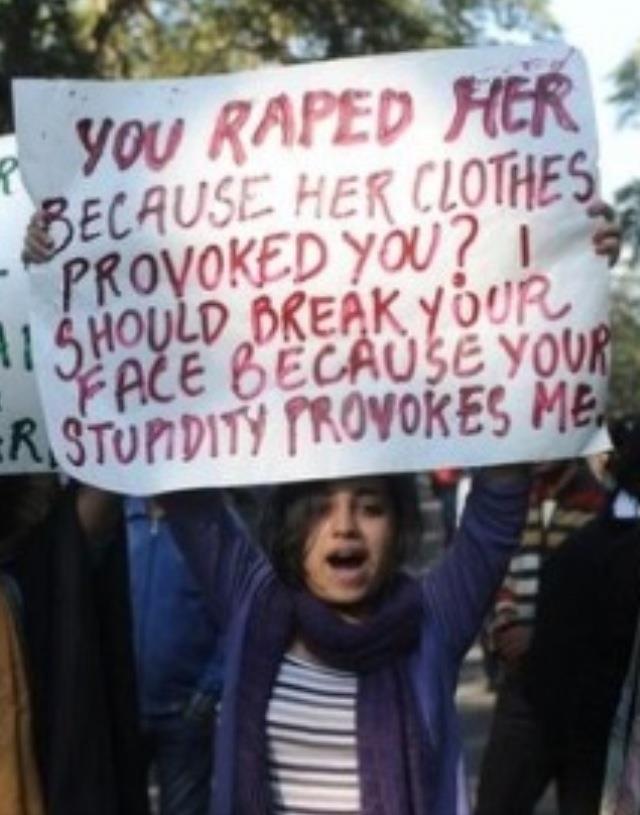
The historical approach of Christian men towards women is similar to the approach found in strict Islamic countries today, with controlling rules on female dress and appearance. Tertullian (160-225CE), the great Church Father, wrote that "having people lusting after you with carnal desire is not a desirable state of affairs but is something execrable. [...] For as soon as a man has lusted after your beauty, he has in his mind already committed the sin which his lust was imagining and he perished because of this, and you [women] have been made the sword that destroys him"17. Tertullian strongly condemns women who dress nicely, and states that it is a requirement for every Christian woman to dress unattractively, a theme which is taken up with his writings such as On the Veiling of Virgins; for example in Book 1 Chapter 1 he warns against women "adorning yourself over and above your tunics of skins".
“Already, years before Augustine would finally formulate for the West the doctrine of Original Sin, the emotional trinity which exists at the heart of that doctrine has been formed in the Christian neurosis of Tertullian: women, sex and sin are fused together in his mind indissolubly. The only hope for man is that women hide themselves away - veil their faces from man's lustful eyes, hide their beauty by disfiguring themselves and make themselves ugly and sexless.”
"The Gospel According to Woman: Christianity's Creation of the Sex War in the West"
Karen Armstrong (1986)18
Unfortunately, his misogynistic rantings have a good biblical basis. Matthew 5:28 says that "everyone who looks at a woman with lustful intent has already committed adultery with her in his heart".
The epistles of Paul call out women's hair, in particular, as being the source of beauty. In 1 Corinth. 11:6-7 he says that women must therefore cover their heads when they pray, and if she doesn't, she should be forcibly shaven. Also in 1 Tim. 2:9 he states that women shouldn't have braided hair - or, "gold or pearls or expensive clothes". There are no such equivalent rules for men..
It is not just human males that are at risk from the beauty of women. In The Veiling of Virgins Tertullian explains that the angels themselves fall from grace because of the beauty of Human women19, and it is 'because of the angels' that human women must conceal themselves with course and unshapely clothes. He doesn't describe it in terms of the angels being sinful, however, but that this beauty is "driving the angels from their heavenly home" as if it is the women's fault. He lives in a world of compulsion, of complete lack of self-control, of poor moral training during upbringing, where others have to stay out of the way of males and if they don't, it is their own fault! Many other Church Fathers say the same: Jerome (347-420CE) uses the same language, "a woman drove the tiller of Paradise [Adam] from the garden that had been given him"20. In other words, it is male weakness and male guilt for letching at women that is the driver for this hate. This inglorious and hypocritical turning of the blame from men to women has been a common theme throughout Christianity in history, and through Islam in the present.
6. Biblical Dress Codes: God's Laws on Clothes
See:
- Laws and Rules on Clothes in the Bible
- Why Women Must Cover Their Hair
- All Laws of the Bible Must be Followed, Both Old and New
7. The Christian Synods of the 12th Century: No Long Hair and No Pointy Shoes21
In the year 1102 at a national synod held at Westminster, with King Henry in attendance, the Christian rulers saw to it to declare, in an age of strife, poverty and violence (much of those things caused by the clergy themselves), that the men amongst the laity (i.e., the public) were not allowed to have long hair. The archbishop, Anselm, had preached against the male public having long hair for a long time and refused important Christian rites to them. This wasn't a concern peculiar to the Roman Catholic Church in England. The Bishop of Seez in Normandy had previously gave King Henry a lengthy telling-off about his long hair, and went on about it so much, that the King right there and then had it cut to the length expected of him by the Bishop22. At that synod, it wasn't just hair styles that were bothering the godly. They also had it in for pointy decorative shoes. The historian David Hume describes the battle, and in his excellent and humorous English, describes how the Church simply could not get its way:
“They declaimed against it with great vehemence, nay, assembled some synods, who absolutely condemned it. But, such are the strange contradictions in human nature! Though the clergy, at that time, could overturn thrones, and had authority sufficient to send above a million of men ... to the deserts of Asia, they could never prevail against these long pointed shoes: on the contrary [the fashion] maintained its ground during several centuries; and if the clergy had not at last desisted from their persecution of it, it might still have been the prevailing fashion in Europe.”
"The History of England, Volume I" by David Hume (1688)22
After the expulsion of Anselm, church authorities wrote to him over time expressing increasing concern about the state of spirituality in Britain. The "most shocking" customs were returning "and the practice of wearing long hair gain[s] ground among all ranks of men, and these enormities openly appear every where without sense of shame or fear of punishment"23. But how bad could long hair really be? "The total extinction", they warned, "of religion and Christianity were likely to ensue"23.
As an interesting aside, it is perhaps worth pointing out Samson in the Old Testament not only had long hair, but was blessed by God with it as a source of strength, and that most depictions have Jesus himself keep long (ish) hair.
8. Religious Clothing Laws As Dangerous Superstitions
As a result of religious rules and dogmas on clothing, jewellery, accessories and hair there are some conflicts between traditionalists and the non-religious. It is a battle between superstition and common sense, especially given the mythological and illogical nature of most of those inhibitions. There are no rational theological reasons why the creator of the universe would care about how we fashion animal skins and products of the loom, and how we choose to drape them on our bodies. Morality is an important social value. But with good morals, you remove the requirement for clothing rules. Conversely if society lacks morals, clothing rules are irrelevant. The reason, therefore, that there are such strict dogmas in some religions/religious cultures, derives from flawed non-divine Human sources.
“Even apparently innocuous beliefs, when unjustified, can lead to intolerable consequences. Many Muslims, for instance, are convinced that God takes an active interest in women's clothing. While it may seem harmless enough, the amount of suffering that this incredible idea has caused is astonishing. The rioting in Nigeria over 2002 Miss World Pageant claimed over two hundred lives; innocent men and women were butchered with machetes or burned alive simply to keep that troubled place free of women in bikinis. Earlier in the year, the religious police in Mecca prevented paramedics and firefighters from rescuing scores of teenage girls trapped in a burning building. Why? Because the girls were not wearing the traditional head covering that Koranic law requires. Fourteen girls died in the fire; fifty were injured.”
"The End of Faith: Religion, Terror and the Future of Reason" by Sam Harris (2006)24
See: Why Question Beliefs? Dangers of Placing Ideas Beyond Doubt, and Advantages of Freethought:
